Shift Point Check-- AOD
Shift Point Checks AOD Road Test
This check will determine if the governor pressure and shift control valves are functioning properly. During the shift point check operation, if the transmission does not shift within specifications or certain gear ratios cannot be obtained, refer to the diagnosis wheel or to the symptom analysis Section to resolve the problem. Symptom Related Diagnostic Procedures
Shift speed specifications can be found in the Technical Service Bulletin-Special Specifications Issue.
Choke on will effect shift points minimum throttle upshifts. Check minimum throttle upshifts in the fourth gear (overdrive). The transmission should start in first gear, shift to second gear then shift to third gear and finally shift to fourth gear, within the shift points specified in the shift speed specifications.
Forced Downshifts
With the transmission in fourth gear (overdrive) depress the accelerator pedal to the floor. The transmission should downshift to third gear or to second gear, depending on vehicle road speed. Refer to the appropriate shift speed specifications.
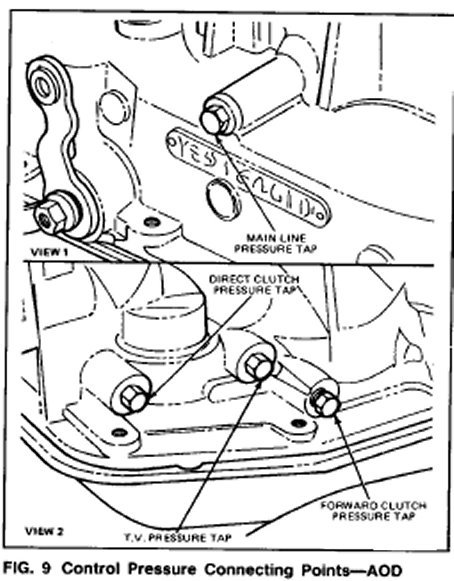
Closed Throttle Downshifts
Closed throttle downshifts should be extremely difficult to detect. It may be necessary to attach pressure gauges to the forward and direct clutch pressure taps (Fig. 9) in order to detect 4-3 and 3-2 coast downshifts.
With gauges attached a 4-3 coast (closed throttle) downshift is signified by the application of the forward clutch (the psi reading from the gauge on the forward clutch pressure tap will indicate an increase in pressure from 0 psi to 60 psi). A 3-2 coast downshift is signified by the release of the direct clutch (the psi reading from the gauge on the direct clutch pressure tap will indicate a decrease in pressure from 60 psi to 0 psi). A 2-1 coast downshift should be imperceptible. The coast downshifts should occur within the limits set forth in the shift speed specifications.
When the shift selector is in manual low (1) the transmission will not upshift from first gear.
When the shift selector is moved from either OD (overdrive) or direct drive (D) ranges to the manual low (1) position, the transmission will downshift into second gear if the vehicle is moving over (approximately) 41 km/h (25 mph) and into first gear if the vehicle is moving less than (approximately) 41 km/h (25 MPH).
The overdrive band is applied when the transmission is in manual second. The low-reverse band is applied when the transmission is in manual first gear.
The automatic overdrive transmission will not shift into fourth gear (overdrive) at wide open throttle.
The Automatic Overdrive Transmission will not make a 4-1 downshift.
When the vehicle road speed drops below approximately 58 km/h (35 mph), the transmission automatically downshifts from (D) (overdrive) into third gear.
Shift Point Checks In Shop AOD
A shift test can be performed in the shop to check shift valve operation, governor circuits, shift delay pressures, throttle boost and downshift valve action.
Raise the vehicle with an axle or frame hoist so that the rear wheels are clear of the floor.
CAUTION: Never exceed 96 km/h (60 mph) speedometer speed or rapidly apply the brakes to stop the rear wheels.
To check the shift valves and governor circuits, place the transmission in overdrive and make a minimum throttle 1-2, 2-3 and 3-4 shift test. When the shift occurs you will see the speedometer needle make a momentary surge and feel the driveline bump. If the shift points are within specification, the 1-2, 2-3 and 3-4 shift valves and governor are OK.
If the shift points are not within specification, perform a Governor Check to isolate the problem.
Place the transmission in manual 2, no load on the engine and apply 10 inches of vacuum to the vacuum diaphragm unit. Increase the speed slowly and watch the speedometer. Check the mph at which the control pressure cutback occurs. it should occur between 16-32 km (10-20 mph).
NOTE: After each test, move the selector lever to N (Neutral) and run the engine at 1000 rpm to cool the transmission.
Decrease the vacuum at the vacuum diaphragm to 0.2 inches. Repeat the check. Control pressure cutback should occur between 48-80 km (30-50 mph).
The governor is good if the cutback occurs within these specifications. If the cutback does not occur within specifications, check shift speeds to verify that it is the governor and not a stuck cutback valve, then repair or replace the governor.
Shift speed specifications can be found in the Technical Service Bulletin-Special Specifications Issue.
Diagnosis Tips AOD Only
Some tips on diagnosing problems with specific components are:
INTERMEDIATE CLUTCH OR ONE-WAY CLUTCH-transmission shuts 1-3 or slips in second gear.
REVERSE CLUTCH-slip or no engagement in R. (Also can be caused by the low-reverse band or servo.)
FORWARD CLUTCH/PLANETARY LOW ONE-WAY CLUTCH-no engagement in forward ranges or slip in forward.
OVERDRIVE BAND OR SERVO-no fourth gear, slip in fourth gear, or no engine braking in second gear in range 1.
DIRECT CLUTCH-slip in third or fourth, or no upshift beyond second.
LOW-REVERSE BAND OR SERVO-no reverse or slip in reverse. Possibly no engine braking in manual low first gear, which would isolate the problem to the band rather than reverse clutch.