Control Pressure Test
Control Pressure Test
AOD
Line pressure and throttle pressure on the Automatic Overdrive Transmission is tested in the idle position (zero T.V.) and wide-open-throttle position. Line pressure and throttle pressure specifications can be found in the Technical Service Bulletin-Special Specifications Issue. In each of the two modes the Reverse specifications will be higher than the others.
1. Be sure the T.V. linkage is properly adjusted.
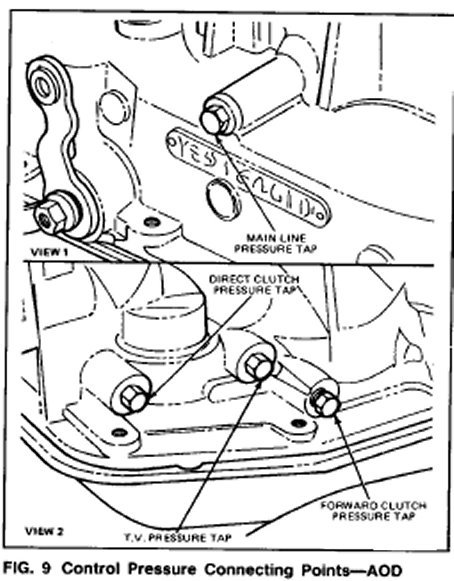
2. Connect a 300 psi gauge to the line pressure port on the case left side lust above the control lever (Fig. 9). Have sufficient flexible hose to make the gauge accessible while operating the engine.
3. Connect a 0-100 psi pressure gauge to the TV port on the right side of the case (see Fig. 9). Have sufficient flexible Hose to make the gauge accessible while operating the engine.
CAUTION: Pressure gauges affect the shift quality of the transmission. Care should be taken NOT to accelerate or decelerate rapidly. Possible transmission failure could result
NOTE: W.O.T. readings are to be made at full stall. However, be sure to run the engine at fast idle in neutral for cooling between test.
4. Run the engine until it is hot.
CAUTION: Idle pressure must be read with the throttle off the fast idle cam.
5. Apply the service and parking brakes firmly and shift through all the ranges. Record the line pressure and the throttle pressure and compare it with specifications.
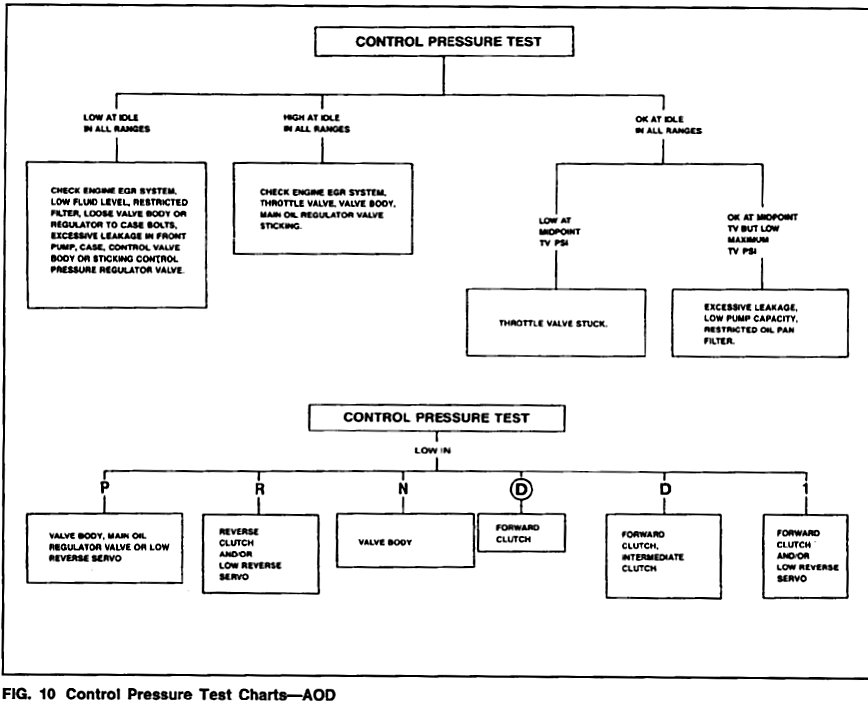
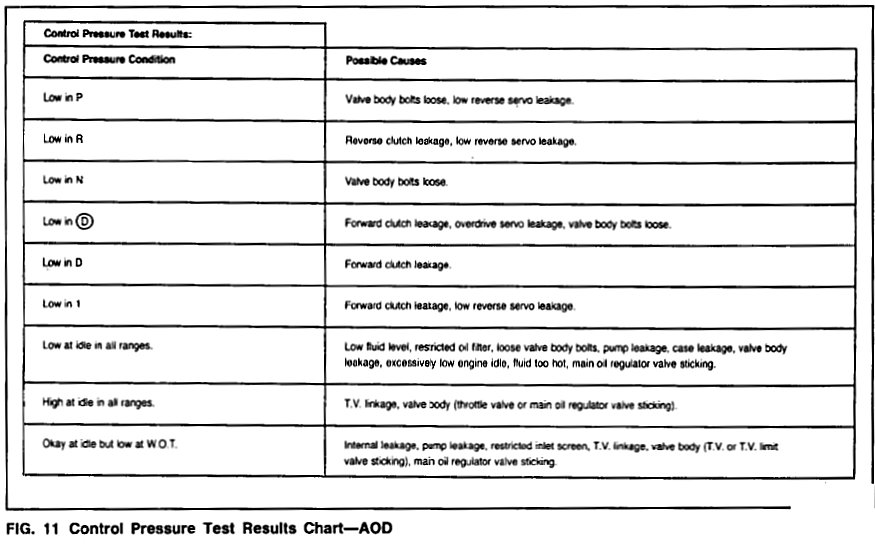
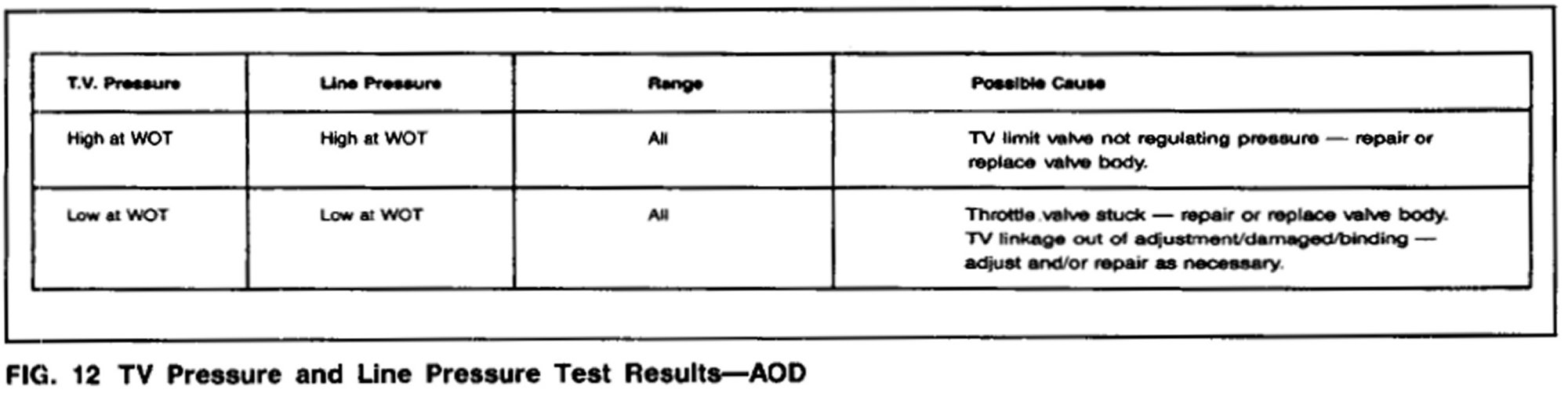
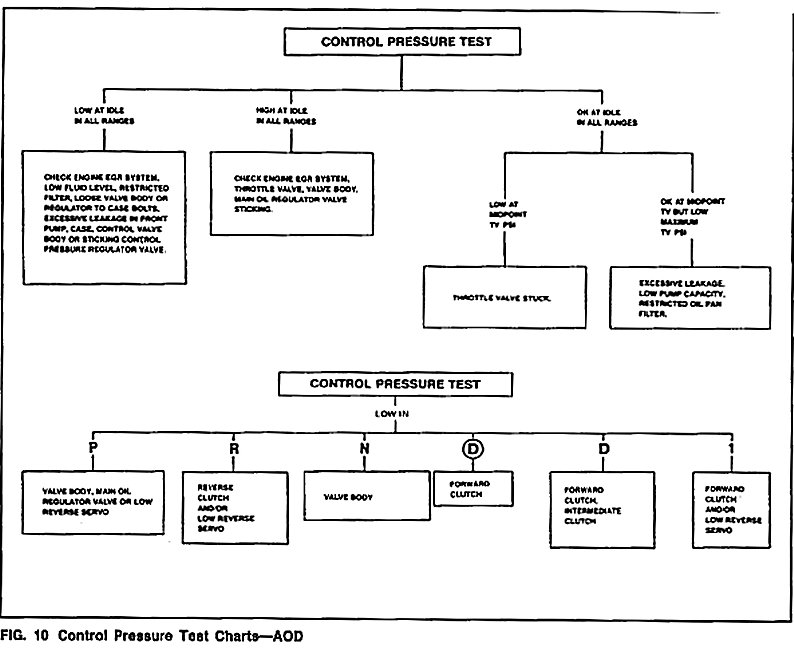
After making the control pressure tests, analyze the results to relate to the conditions in Figs. 10, 11 and 12.
Keep in mind that clutch and servo leakage may or may not show up on the control pressure test. This is because (1) the pump has a high output volume and the leak may not be severe enough to cause a pressure drop; and (2) orifices between the pump and pressure chamber may maintain pressure at the source, even with a leak downstream. Pressure loss caused by a less-than-major leak is more likely to show up at idle than at W.O.T. where the pump is delivering full volume.
Conversely, if you are manipulating the T.V. linkage to simulate W.O.T., but actually testing at idle, the leak is more likely to cause a pressure loss in the W.O.T. position.
To further isolate leakage in a clutch or servo circuit, it is necessary to remove the oil pan and valve body, and to perform case air pressure tests.