Fluid Leakage Check In Converter Area
Fluid Leakage Check In Converter Area
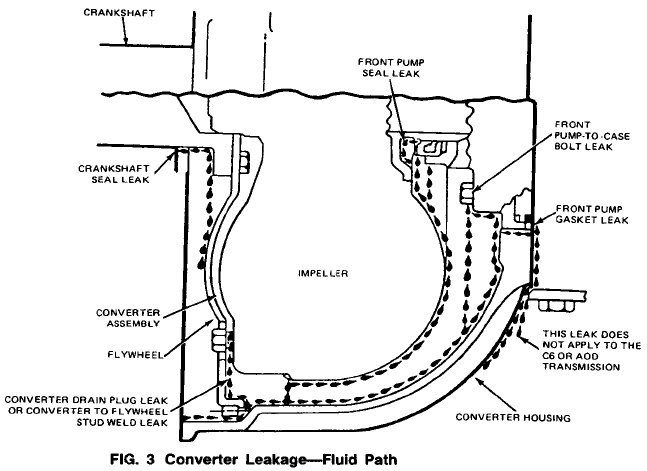
In diagnosing and correcting fluid leaks in the front pump and converter area, use the following procedures to locate the exact cause of the leakage. Leakage at the front of transmission, is evidenced by fluid around the converter housing, may have several sources. By careful observation, it is possible in many instances, to pinpoint the source of the leak before removing the transmission from the vehicle. The paths which the fluid takes to reach the bottom of the converter housing are shown in (Fig. 3).
1. Fluid leaking by the front pump seal lip will tend to move along the drive hub and Onto the back of the impeller housing. Except in the case of a total seal failure, fluid leakage by the lip of the seal will be deposited on the inside of the converter housing only, near the outside diameter of the housing.
2. Fluid leakage by the outside diameter of the seal and front pump body will follow the same path which the leaks by the front pump seal follow.
3. Fluid that leaks by a front pump-to-case bolt will be deposited on the inside of the converter housing only. Fluid will not be deposited on the back of the converter.
4. Leakage by the front pump-to-case gasket may cause fluid to be deposited inside the converter housing, or it may seep down between the front of the case and converter housing. Fluid on the front of the case above the pan gasket on C5 transmissions is evidence that the front pump-to-case gasket or seal could be leaking.
5. Fluid leakage from the converter drain plugs or converter-to-flywheel stud weld will appear at the outside diameter of the converter on the back face of the flywheel, and in the converter housing only near the flywheel.
Engine oil leaks are sometimes improperly diagnosed as transmission front pump seal leaks. The following areas of possible leakage should also be checked to determine if engine oil leakage is causing the problem.
a. Leakage at the rocker arm cover (valley cover) may allow oil to flow over the converter housing or seep down between the converter housing and cylinder block, causing oil to be present in or at the bottom of the converter housing.
b. Oil galley plug leaks will allow oil to flow down the rear face of the block to the bottom of the converter housing.
c. Leakage by the crankshaft seal will work back to the flywheel, and then into the converter housing.
Fluid leakage from other areas, such as the power steering system forward of the transmission, could cause fluid to be present around the converter housing due to blow back or road draft. The following procedures should be used to determine the cause of the leakage before any repairs are made.
a. Remove the transmission dipstick and note the color of the fluid. Original factory-fill fluid is dyed red, to aid in determining if leakage is from the engine or transmission. Unless a considerable amount of makeup fluid has been added or the fluid has been changed, the color should assist in pinpointing the leak. Since road draft may cause leaking power steering fluid to be present on the transmission, this leakage,if present, should be eliminated before checking the transmission for fluid leakage.
b. Remove the converter housing cover. Clean off any fluid from the top and bottom of the converter housing, front of the transmission case, and rear face of the engine and engine oil pan. Clean the converter area by washing with a suitable non-flammable solvent, and blow dry with compressed air.
c. Wash out the converter housing, the front of the flywheel, and the converter drain plugs. The converter housing may be washed out using cleaning solvent and a squirt-type oil can. Blow all washed areas dry with compressed air.
d. Start and run the engine until the transmission reaches its normal operating temperature. Observe the back of the block and top of the converter housing for evidence of fluid leakage. Raise the vehicle on a hoist and run the engine at fast idle, then at engine idle, occasionally shifting to the drive and reverse ranges to increase pressure within the transmission. Observe the front of the flywheel, back of the block (in as far as possible), and inside the converter housing and front of the transmission case. Run the engine until fluid leakage is evident and the probable source of leakage can be determined.